Bilgisayarlı Tomografi Görüntülerinde Otomatik Böbrek Taşı Tespiti İçin Derin Öğrenme Modelinin Geliştirilmesi


International Conference on Endourology, Valencia, İspanya, 8 - 10 Ekim 2026, ss.50-51, (Tam Metin Bildiri)
- Yayın Türü: Bildiri / Tam Metin Bildiri
- Basıldığı Şehir: Valencia
- Basıldığı Ülke: İspanya
- Sayfa Sayıları: ss.50-51
- İstanbul Üniversitesi Adresli: Evet
Özet
Introduction & Objectives
Kidney stone disease is a common health problem with a high recurrence rate. Non-contrast computed tomography (CT) is considered the gold standard imaging modality for its diagnosis. However, manual interpretation of CT images is time-consuming and may lead to interobserver variability. This study aimed to develop a deep learning model for the automatic detection of kidney stones on CT images.
Materials & Methods
A total of 30,907 CT images without kidney stones and 6,284 CT images with kidney stones obtained from publicly available databases were included in the study. To reduce class imbalance, data augmentation techniques were applied, increasing the number of stone-positive images to 26,807. A convolutional neural network (CNN)-based deep learning model was developed using Python and the TensorFlow library. In addition, a web-based application was created to facilitate the use of the model.
Results
The model achieved a ROC-AUC of 95.5%. The F1-score was 90.7% for the stone-positive class and 92.6% for the stone-negative class (Table 1). The confusion matrix is presented in Figure 1, while Grad-CAM visualizations are shown in Figure 2.
Table 1.Performance metrics of model
Accuracy (%) Recall (%) Precision (%) Specificity (%) F1 Score (%) ROC-AUC (%) Kidney stone present 94,4 87,4 94,2 95,5 90,7 95,5 Kidney stone absent 94,4 95,5 89,9 87,4 92,6 95,5
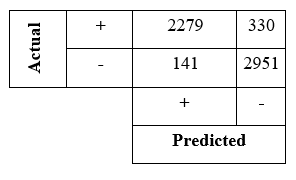
Figure 1. Confusion Matrix
Conclusions
The developed model demonstrated high performance in the detection of kidney stones and showed potential as an effective diagnostic tool. Artificial intelligence–based approaches may support clinical decision-making processes in the diagnosis of kidney stone disease.